
The Texas Rangers entered the All-Star Break with a 49-47 record. This was good enough for first place in the AL West. The Houston Astros are not the insane juggernaut they once were. They are merely a good team with the best active hitter in the AL: Yordan Alvarez. The Astros lack the tremendous starting pitching depth that was the backbone of their division dominance. Their lineup no longer features Kyle Tucker, George Springer, or Carlos Correa. Ranger killers Jose Altuve and Yordan Alvarez are still present. The Astros sit three games behind the Rangers currently. The Seattle Mariners are the team closest on the Rangers heels. They sit 1.5 games back. They still have great starting pitching, but their star catcher Cal Raleigh injured his oblique early in the year and has been ineffective all season. The Mariners, like the Astros, are a good team. Both squads will probably finish around 87-91 wins.
The state of Houston and Seattle is worth considering because the strength of the division will dictate if the Rangers BUY or SELL at the deadline. The division being very winnable is the lens through which the trade deadline should be viewed. The current roster is a piece or two away from being able to win 90 games. The Rangers have been a plucky, competitive team in the last 30 games. The insertion of youngsters into the lineup in place of beleaguered, broken down veterans allowed the offense to have some life. This new spark of life from the call-ups is evident when contrasted with the tepid, lifeless performances of the team through the initial 70 games.
Justin Foscue has been absolutely electric as of late. The versatile utility man leads the team in OPS+ at 160. 100 is always average, higher is better. Foscue has shown flashes of brilliance in the past, but was derailed by injuries. He has shown this season he deserves to start every day. Foscue has been the most potent of the Rangers call-ups, but Nicky Lopez has also gotten looks at middle infield in lieu of Josh Smith and Corey Seager. Lopez is 31 and is hitting .324. Both of these players really pass the eye test in terms of approach. They play selflessly and correctly. The stark difference between a Nicky Lopez opposite field single and a Corey Seager strikeout is one that has colored the last 30 games or so of the season. Is Lopez better than Seager? No, of course not. Will the Rangers start Seager over Lopez once healthy even if Lopez leads the AL in batting average? Yes, because the Rangers are mired in a sort of sunk cost fallacy with Corey Seager at the moment. The star shortstop has the biggest contract on the team. A ten year megadeal. When healthy and at the peak of his powers, he is a top 5 hitter in MLB. He ranks behind Shohei Ohtani, Aaron Judge, and Yordan Alvarez. But this season Seager has looked awful. Not just injured, but slow and ineffective. Getting Seager’s wretched .182 batting average out of the lineup was key to allowing the lineup to flow again. The elephant in the room is Seager’s insane contract, which pays him over $30 million per year until 2031. Ineffectiveness cascading into back injury has decreased Seager’s trade value. He has the sort of contract no one wants to take on the back end of. With Seager at his lowest value ever, moving him makes little sense. So why even bring up trading him if it is unlikely? Because his presence in the clubhouse and payroll seems more expendable every time Nicky Lopez gets a hit and extends a rally. Most importantly, the Rangers pay Seager so much money that they are never going to bench him.
Corey Seager is seen as the variable that divides the insanely boring “checked out” offense that tortured Rangers fans for the last two seasons. Is it fair? Probably not. When healthy, Seager has been very good for Texas. He posted 6.1 WAR (All-Star level) last year despite missing 60 games. Stats like this fall on deaf ears for anyone who has seen Corey this season though. He looks like a different player. Due to his injury and cold streak, the Rangers would be better off holding on to Seager. He could very easily get healthy in August and become a torrential force again. Trading him for chiclets makes little sense in this regard. Even if the Rangers decide to move on from Seager, it will probably be done in the offseason.
The New York Mets bottomed out in April, and are already out of contention. The Metsian 12 game losing streak set the Mets back so badly color commentator Keith Hernandez was lamenting live on air his disappointment in his sons for not having children. The Mets imploded so catastrophically in APRIL that their commentator was lamenting the death of his bloodline before the All-Star Break. One hilarious idea would be to swap Corey Seager for flamboyant, flashy, underperforming Mets shortstop Francisco Lindor. The Rangers sent their second baseman, Marcus Semien, to New York this last offseason. He clearly does not like it there, reacting with visible disgust to Lindor’s foolish errors in the field. Lindor boots balls, forgets how many outs there are, and does not cover 2nd during some double plays. Lindor, like Seager, is on a massive contract. The subtext of the Semien trade was an apparent rift between him and Corey Seager. Both players are quiet grinders. In a classic tale of “grass is always greener,” Semien has looked miserable in NY watching Lindor make errors with the confidence and bravado of someone who has YEARS of guaranteed money. Seager and Semien might not have “liked each other off the field,” but Marcus could always rely on Corey to be in position for a double play.
Because of the absurd size of Seager’s contract, one of the only ways to offload it is to swap it for another bad contract. This means one of the only ways Seager will be dealt at the deadline is for Francisco Lindor, thus hilariously reuniting him with Marcus Semien. Semien would presumably greet Seager like a lost comrade. Semien and Seager are both remarkably boring players with little flair in their game. You would think they would have gotten along swimmingly, one grinder content to hit the other with clean double play tosses. Instead, Marcus has spent this season on the LOLMets Express, sometimes called the Number Seven Train. He watches Lindor’s braids flying around erratically as he boots a crucial ball in the 9th, smiling from ear to ear. Lindor cares about the flash and the sizzle more than making the correct “macro” play. He is style over substance like the band KISS. Unlike KISS, Lindor is actually kind of cool sometimes though. Reuniting Seager and Semien on the laughingstock New York Mets would be baseball high comedy. It is the sort of trade, like A-Rod to New York, that is sure to produce headlines for years to come. Will it happen? 5% chance. But understanding the limitations of trading a contract like Seager’s is important. Even without a HARD SALARY cap, teams do not want to go into the luxury tax threshold. Baseball does not have a hard salary cap. It has a soft salary cap, which means that teams that spend above the “cap” get taxed heavily. Even Mets billionaire owner Steven Cohen has said he is not willing to spend the luxury tax money. So no one wants to take on these monster contracts without offloading one of their own.
The New York Mets, sometimes called the LOLMets by people familiar with their history, are a putrid 40-57 at the break. They will look to offload talent at the deadline, another season of misery to be filed away in the annals of Mets failures. This is relevant not just for the Lindor bit, but because their bullpen is stacked and the Rangers need to add some bullpen help. As it stands, the Rangers rely way too much on All-Star fireman reliever Jacob Latz. The Mets have three excellent arms in the pen the Rangers should target: AJ Minter, Luke “Dreamweaver” Weaver, and Brooks Raley. All three of these guys have ERAs+ above 200. 100 is always average, higher is better. This means they are over twice as good as an average reliever. The Rangers bullpen has been managed well by the rookie Skipper Skip Schumaker. But Schumaker needs to have legitimate options to go to from the bullpen. The build order of riding your starter for 7 innings and then letting Jacob Latz get a 6 out save is not sustainable. This is especially true with Kumar Rocker being deeply flawed and a fringe fifth starter. Rocker struggles with command issues. He struggles with the lineup the third time though. He struggles getting guys out that don’t wave at his slider. He struggles in the first inning. He is not going to give you 7 strong. You need effective middle relievers. This is especially true in the playoffs. The Rangers biggest need by far is bullpen help. Expect the Rangers to do some sort of deal with the laughingstock Mets before the deadline. It probably won’t include Corey Seager, but that possibility is there. The Mets spent last offseason letting beloved guys like Pete Alonso walk. Mets owner Steve Cohen is tired of his team underperforming and could potentially look to shake up the core of his team even harder. He seemingly got rid of everyone he should have kept, added no real pitching, and pretended the Mets would be a playoff team. This is an important piece of context when considering a potential Seager/Lindor deal. Maybe Cohen is fed up enough to make a blockbuster deal like that. It seems unlikely Seager gets traded, but if it is anywhere it will be the Mets. Seager notwithstanding, the Rangers should look to aggressively pursue the aforementioned bullpen arms. Weaver and Minter are both playoff proven, high leverage stars.
The Rangers could potentially look to add a utility infielder or outfield bat at the right cost, but it seems unlikely. The bullpen is so clearly their weakness that speculating about other additions seems silly. One of the Rangers biggest strengths is position versatility. Many of their players are dynamic and athletic and can play multiple positions. Zeke Duran, who currently leads the team in WAR, is a great example of this. He has played all over the field. Josh Smith, Justin Foscue, Nicky Lopez, and Cam Cauley also have this ability. Their versatility means getting another utility style player has limited value. Yet top end sluggers are rarely on the market at the deadline. If flexibility has been the lineup’s biggest strength this season, who is the most inflexible, rigid player on the roster in terms of position/obligation to start? Corey Seager… You can see why the idea of trading him is on the mind of many Rangers fans despite his talent and unmoveable contract.
Third baseman Josh Jung was very good through the first half of the season. He has cut his chase rate way down. His walk rate is improved. He is striking out less. He has matured as a hitter and is no longer easily vexed by sweepers/sliders outside the strikezone. Jung has played 87 games this season. His good health has been an important part of his success at the plate. Jung has looked poised to break out into stardom in the past, only to be derailed by injuries. He seemingly never gets injured when in a slump. He has been a joy to watch this season.
Utility Star Zeke Duran, as mentioned earlier; leads the team in WAR at the All-Star Break. Duran’s defensive metrics are staggering. Once viewed as a “bat-first” player who was somewhat positionless with a good arm, Duran has become a top end defender wherever he is slated in the field. He ranks in the top 2% of the league in defensive range (Outs Above Average) and has a top end arm as well. He ranks in the top 10% of the league in sprint speed too. He has cut down his chase rate at the plate too. He is swinging at fewer bad pitches that are unhittable. This is allowing him to leg out singles on balls he can subsequently put in play during that extended at bat. Duran, like Jung, has improved his approach at the plate. He is swinging at fewer balls out of the zone.
Speedy outfielder Wyatt Langford has been brilliant when healthy. Langford’s season started slow due to injury. His combination of power, speed, and defense make him one of the Rangers most exciting young players. The former first round draft pick continues to develop into a cornerstone for the Rangers.
Langford’s partner in crime, Evan Carter, was supposed to patrol the outfield in Texas for the foreseeable future. Carter’s meteoric rise in 2023 came at the Rangers low point. The slugging lefty was deemed “The Little Savior” by his beleaguered, battle-worn veteran allies. Carter was able to stop the bleeding as the Rangers were hammered with injuries and losses during the dog days of August. He also consistently raked in the playoffs. He looked like an established veteran. A phenom kid prospect who did not rattle or shake. Carter was an important part of the 2023 title run. Like Langford, his extreme talent level being shown off at such a young age got Rangers fans excited. Carter posted a 1.058 OPS at the end of the 2023 regular season to help prevent a catastrophic collapse. Facing top end playoff pitching, The Little Savior managed a .917 OPS over 72 plate appearances.
Carter dealt with back issues that sidelined him for large portions of the next three seasons. But even when healthy he looks like a totally different player. It is worth noting the back issues existed before the Rangers drafted him. Thus his insane dropoff cannot merely be dismissed by injury. He was always viewed as a guy who struggled with the lefty/lefty matchup. This has not changed. In fact, it has gotten worse. He cannot even hit bad lefties. The more worrisome thing is his inability to hit right-handers. He still walks a lot, retaining great plate vision. But Carter’s OPS the last three seasons are: .633, .728, and .635. He went from a key piece to merely a fast, fourth outfielder type. Alejandro Osuna has gotten looks in his place. Carter can find his peak form again, his 2023 run was not an aberration. Carter finding his form again is one of the Rangers biggest win conditions. One can agonize about trades that probably will not happen, but getting their former top prospect back to his 2023 level would move the needle for the Rangers offense more than trading for any slugger on the market.
Brandon Nimmo has been the other primary outfielder this season. He has been a consistent asset. Perhaps the best thing about Nimmo’s arrival was the fact he spared Rangers fans from another brutal Marcus Semien “slow start.” Semien takes about two months to get into playing shape every season. This listless approach left the Rangers in massive holes early in the past two seasons. Marcus lazily coasting up in New York was comedically overshadowed by his new best friend and double player partner Lindor forgetting to cover second. Semien’s unprepared, sloppy routine condemned the Mets to the 12 game losing streak that sunk their season in the harbor. Semien’s unprofessional preparation habits seem to be forgiven because he plays so many games. The fact that he wades listlessly through the first 60 is apparently absolved by the fact he is going to play the next 102. Mets fans got to enjoy this tired shtick to the tune of -0.6 WAR, a .214/.271/.341 slash line, and a career low 70 OPS+. Semien’s primary contribution to the Mets this season was shooting dirty looks of disbelieving disgust at Lindor after the latter made a mental error Corey Seager never would. Nimmo’s advanced stats are staggering. He ranks top 8% in MLB in xwOBA, xBA, xSLG, AVG Exit Velo, and Hard Hit %. X stands for expected, W for weighted. In other words: he has been good, but has been HAMMERING the ball and getting somewhat unlucky. Nimmo will continue to hit the ball hard in the second half. Another GM Chris Young trade victory.
The catching position has been pretty poor for the Rangers so far this season. Elias Diaz has been the best of the lot. Danny Jansen and Kyle Higashioka have been forgettable. Jonah Heim’s fall from grace after he was ridden into the ground during 2023 was sad to watch.
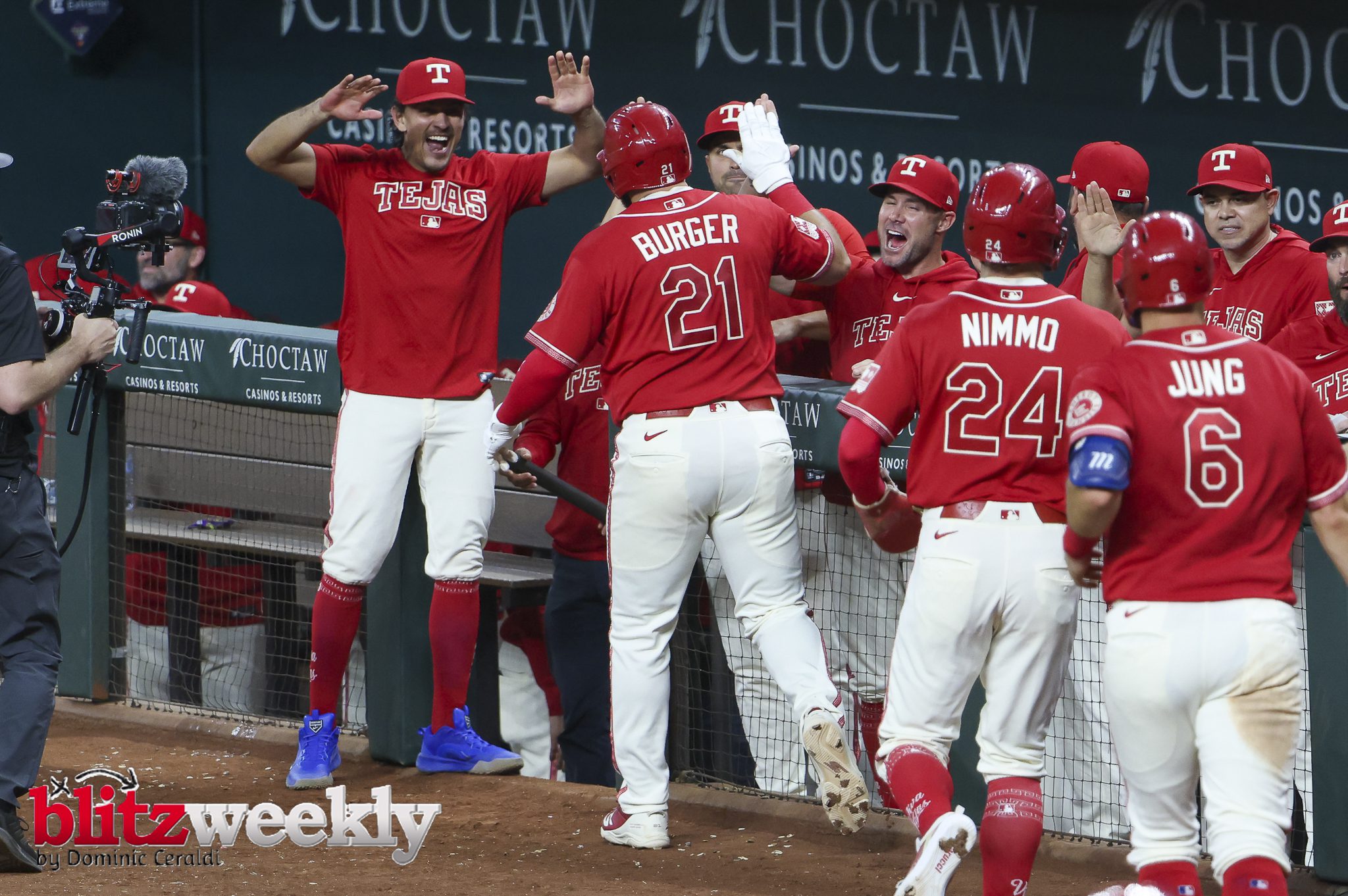
Jake Burger started off last season very cold. He was brought in to be a standard, slugging first baseman. The sort of slugger that posts lots of 1-4’s with an extra base hit. He has found his rhythm in Texas. He plays solid defense. He swings hard and does not get cheated up there. When he does make contact, he often hits it far. Burger has fulfilled his role this season, being an average slugger with pop.
Joc Pederson also started off last season slow. He has also started to look like the player the Rangers thought they were getting when they signed him. Joc has provided pop from the top of the lineup. Like Burger, he has a good amount of swing and miss in his game, but puts the ball in play with force.
The Rangers are a good team that plays in a weak division. They are a few bullpen arms away from winning the 90 games required to secure the division title. The clear path to the playoffs dictates that the Rangers buy at the deadline. They do not have to be that good to make the playoffs. But they have the top end starting pitching to do real damage in the playoffs if they make it there.
Ace pitcher Jordan Montgomery will be back soon. So will plucky southpaw Cody Bradford. Both these warriors have been trapped in a repulsive post-title purgatory since 2023. They have been injured and underappreciated since they helped the Rangers to their first title. The sheer lack of innings pitched from both of them has allowed them to slip the mind of many Rangers fans. The Rangers approach the trade deadline in first place and with zero bullpen depth. Jacob Latz has been asked to do the work of three top-end arms. He has succeeded in this absurd request, but he needs reinforcements.